Le Pr Stéphane Rousseau invité à animer un séminaire à la Libera Università Internazionale degli Studi Sociali (LUISS) à Rome.
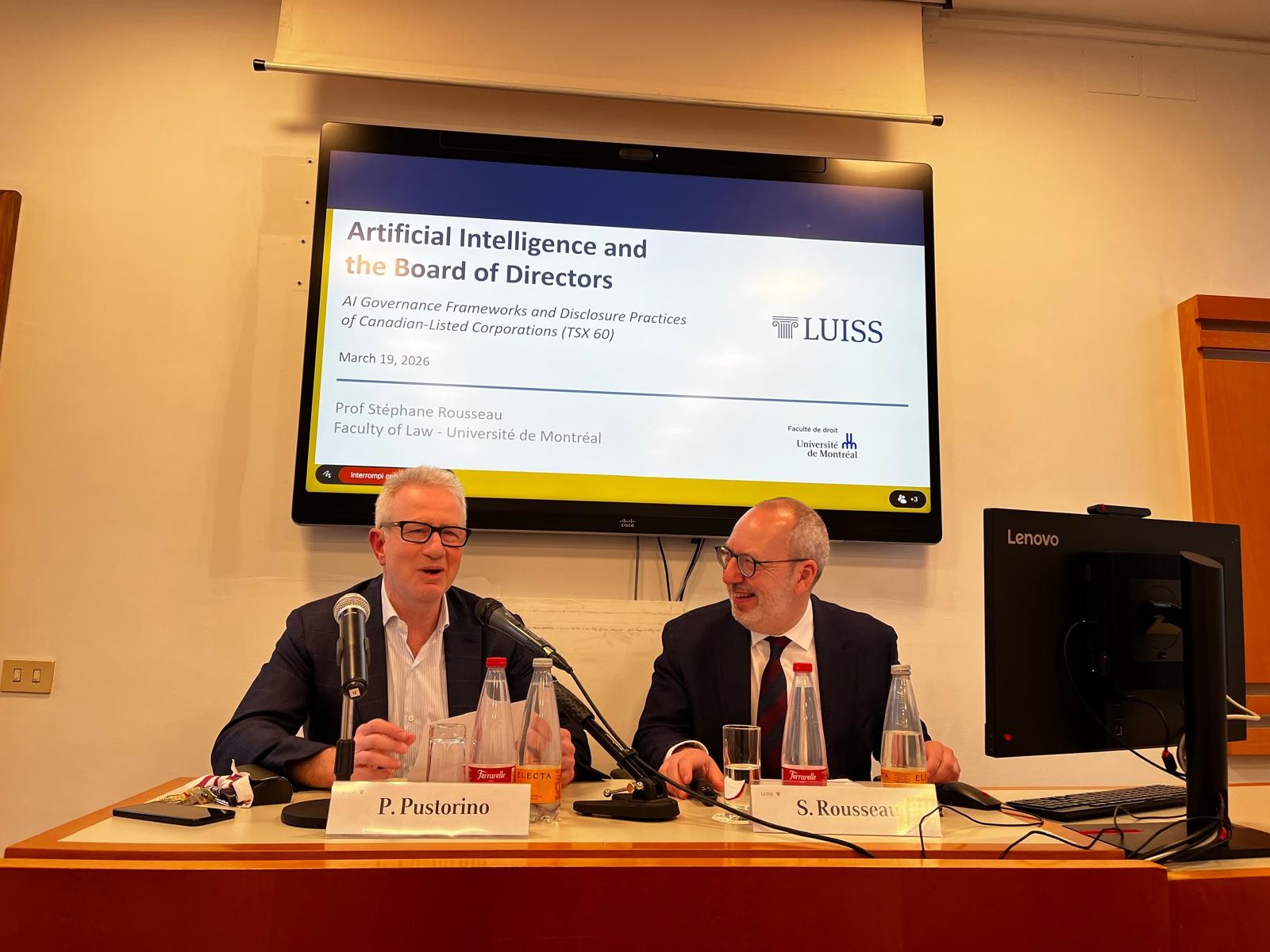
Organisé conjointement par le LUISS Department of Law and Institutions et le Department of Business and Economic Law, le séminaire avait pour titre Artificial Intelligence and the Role of the Board of Directors: A Look at the Experience of Canadian-Listed Corporations. Il prenait appui sur une étude coécrite avec la Pre Catherine Régis de la Faculté de droit de l’Université de Montréal, dont voici le résumé :
This article examines the state of artificial intelligence (AI) governance among Canadian publicly listed companies, with a focus on the role of boards of directors in overseeing AI-related risks and opportunities. Drawing on the Canadian corporate governance framework — including directors’ fiduciary duties and duty of care under corporate law, and the comply-or-explain approach adopted by the Canadian Securities Administrators (CSA) — the article situates board oversight of AI within both shareholder primacy and stakeholder theory perspectives. An empirical study of TSX-60 listed companies, based on regulatory filings and structured content analysis, reveals a significant gap between the widespread recognition of AI as a material risk factor and the formal integration of AI governance into corporate architecture. Building on this empirical foundation, the article surveys emerging best practices from academic literature, proxy advisory guidelines, shareholder proposals, and international governance codes. It concludes that existing Canadian governance standards, though partially responsive, remain insufficient to address the complexity and urgency of AI-related challenges. The article recommends that the CSA revise its corporate governance guidelines using the comply-or-explain approach to promote standardized disclosure, reduce fragmentation, and strengthen board accountability in an era of accelerating AI adoption.
Ce contenu a été mis à jour le 23 mars 2026 à 13h26.
Commentaires